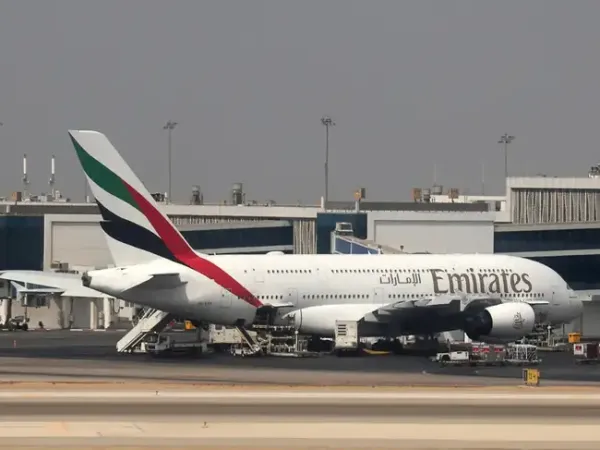
Emirates bets on India capacity relief amid strong travel demand
Dubai: Emirates airline remains optimistic that government-level talks will ease the limit on seats it can sell on flights to and from India, even as demand from the country continues to outstrip available capacity, the carrier's deputy president and chief commercial officer, Adnan Kazim, told ET. Speaking on the sidelines of the World Governments Summit, Kazim said India remains a priority market for the Dubai-based carrier, backed by strong and sustained demand.
"Any progress on capacity would unlock wider benefits for travellers and the broader aviation ecosystem and allow India to play an even more prominent role within our global network...," he said on the sidelines of the World Governments Summit. "We remain optimistic about the direction of engagement between the two governments and the opportunity for enhanced connectivity over time."
The statement comes amid Emirate's recent stance that India was less important for the carrier on account of the bilateral limits.
Kazim said the airline is focused on maximising performance within the existing framework by optimising schedules and connectivity. Earlier, the airline had said that it was shifting its strategic focus away from India amid the restrictions.
"This would ensure the airline is well positioned to scale up quickly if additional entitlements are granted," said Kazim.
Last year, company president Tim Clark had said that demand-supply mismatch in the India-Dubai route was more than two and a half times the weekly seat entitlements of 65,000 on each size, at close to 200,000. A reciprocal cap also applies to Indian carriers flying to Dubai.
These limits have stayed unchanged since 2014 when the air services pact between India and Dubai were last revised in 2014. Similarly, the weekly seat capacity for India and Abu Dhabi stands at 55,000.
Last year, Clark had said at an event in Berlin that India became less important to Emirates as it has not been able to increase capacity to India for more than ten years.
Emirates operates 167 weekly flights to India. Capacity constraints, rather than weakening demand, have pushed India out of Emirates' top five markets into the top 10, Kazim said. "Seat factors are at turn-away levels, which speaks volumes about the demand we are experiencing," he said.
On potential partnerships with Indian airlines, Kazim said Emirates remains open to "commercially meaningful collaborations" such as codeshares and interline agreements that enhance customer choice and connectivity.
He, however, said partnerships alone cannot fully address growth ambitions without adequate international capacity. "For partnerships to deliver their full value, they need to be supported by adequate international capacity without which the scope for incremental connectivity remains limited," he said.
"Any progress on capacity would unlock wider benefits for travellers and the broader aviation ecosystem and allow India to play an even more prominent role within our global network...," he said on the sidelines of the World Governments Summit. "We remain optimistic about the direction of engagement between the two governments and the opportunity for enhanced connectivity over time."
The statement comes amid Emirate's recent stance that India was less important for the carrier on account of the bilateral limits.
Kazim said the airline is focused on maximising performance within the existing framework by optimising schedules and connectivity. Earlier, the airline had said that it was shifting its strategic focus away from India amid the restrictions.
"This would ensure the airline is well positioned to scale up quickly if additional entitlements are granted," said Kazim.
Last year, company president Tim Clark had said that demand-supply mismatch in the India-Dubai route was more than two and a half times the weekly seat entitlements of 65,000 on each size, at close to 200,000. A reciprocal cap also applies to Indian carriers flying to Dubai.
These limits have stayed unchanged since 2014 when the air services pact between India and Dubai were last revised in 2014. Similarly, the weekly seat capacity for India and Abu Dhabi stands at 55,000.
Last year, Clark had said at an event in Berlin that India became less important to Emirates as it has not been able to increase capacity to India for more than ten years.
Emirates operates 167 weekly flights to India. Capacity constraints, rather than weakening demand, have pushed India out of Emirates' top five markets into the top 10, Kazim said. "Seat factors are at turn-away levels, which speaks volumes about the demand we are experiencing," he said.
On potential partnerships with Indian airlines, Kazim said Emirates remains open to "commercially meaningful collaborations" such as codeshares and interline agreements that enhance customer choice and connectivity.
He, however, said partnerships alone cannot fully address growth ambitions without adequate international capacity. "For partnerships to deliver their full value, they need to be supported by adequate international capacity without which the scope for incremental connectivity remains limited," he said.